
刑事侦缉档案4
18 Chinese crew members missing after cargo ship sinks off India_我的网站

一 | (ECNS) — Eighteen Chinese crew members are missing after the bulk carrier M.V. Ocean Winner sank in the Indian Ocean off India's eastern coast on Friday, with two Chinese crew members rescued so far, according to Indian maritime authorities. The vessel sank about 240 nautical miles (444 kilometers) from Paradip Port with 24 crew members on board, including 20 Chinese nationals, three from Myanmar and one from Bangladesh, the authorities said. The Indian Navy and Coast Guard are coordinating the search for the missing crew members, while the Fujian Maritime Safety Administration has dispatched a rescue team to assist. A Fujian maritime official said the Chinese crew members had been sent to work overseas by Fuzhou International Economic & Technical Cooperation Co. Ltd., while the vessel was managed by Ocean Winner Shipping Co. Ltd., a ship management company registered in the Marshall Islands. According to Equasis, a global database for merchant ships, the 28-year-old bulk carrier M.V. Ocean Winner is 225 meters long and 32.26 meters wide, with a deadweight of about 73,000 metric tons. The bulk carrier had left Paradip Port carrying iron ore when it sank Friday, and the cause of the sinking remains unclear, according to Indian maritime authorities. (By Helen Mo & intern Liu Shuangjing) 
 。
。
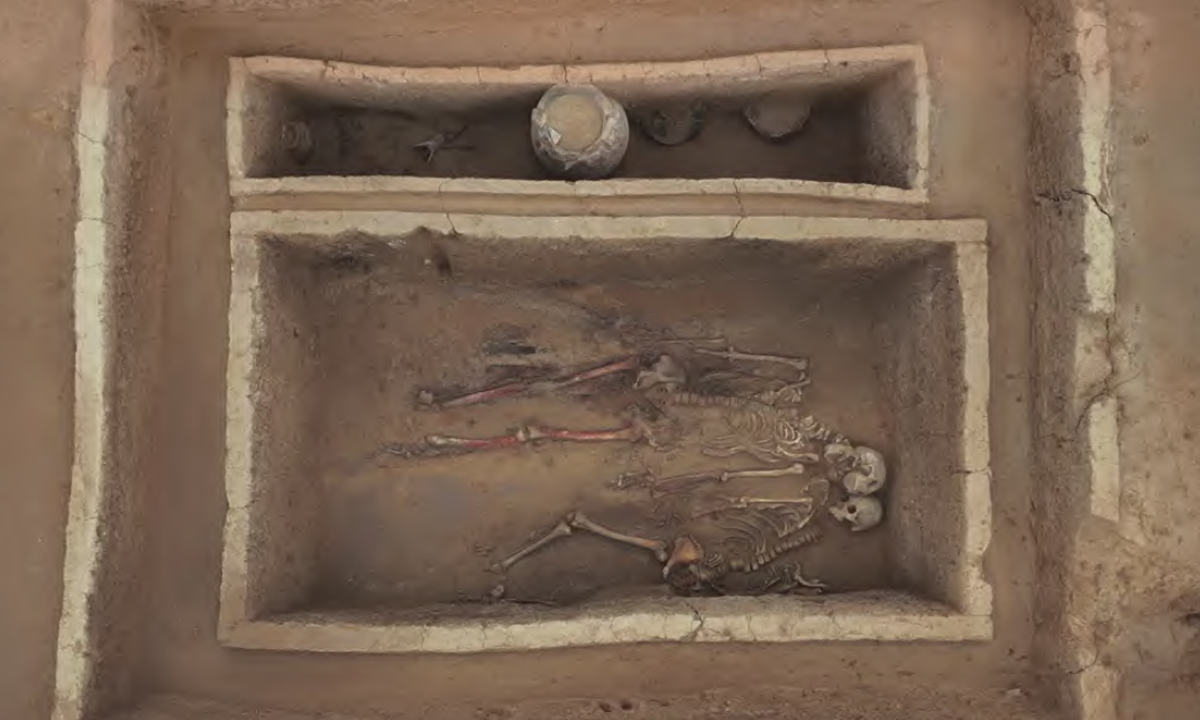
Located on a hilly terrace west of the Taihang Mountains and flanked by the Songxi River, the site was excavated in 2024 and 2025 by the Shanxi Provincial Institute of Archaeology and partner institutions, leading to the discovery of 18 tombs, including six Xia Dynasty burial sites and 12 Warring States Period (475BC-221BC) graves.
"These are the highest-ranking Xia aristocratic tombs discovered so far, indicating that this location was a regional center," the institute said.
The Xia Dynasty is traditionally regarded as China's first hereditary dynasty, though contemporaneous written records are lacking.
The well-organized Xia tombs, concentrated in the western part of the cemetery, feature uniform east-west oriented vertical earthen pits. Researchers recovered nearly 40 sets of artifacts with distinctive local cultural characteristics, including pottery, lacquerware and turquoise ornaments.
Extended regional surveys across the Songxi River valley yielded more than 10 Xia and Shang period sites. Test excavations at nearby relic sites unearthed pottery fragments, stone tools, bronze knives, as well as tin-bronze ingots and smelting residue, providing solid evidence of early metal mining and craftsmanship.
Local copper-iron symbiotic ore deposits confirm exploitation of these resources during the Xia and Shang eras, while typical cultural artifacts found in adjacent counties reveal widespread regional cultural exchange.
Multidisciplinary analyses further decoded the civilization's features. Ancient human remains belong primarily to the ancient population of the Central Plains with minor Mongolian Plateau genetic traits, forming a stable patrilineal clan. The community relied on millet farming and maintained long-distance resource trade networks.
Artifact provenance tests trace scallop shell ornaments to the Bohai Sea, cinnabar to Hunan-Guizhou ore belts, turquoise to the eastern Qinling Mountains area, and coffin timber to local Taihang pine trees. Such diverse materials reflect close interaction among the Taihang foothills, the press release noted.
Lab restoration unveiled refined ritual relics, including a dragon-patterned lacquer cylinder with red and black stripes and an intact lacquer gu vessel (a type of wine vessel). Turquoise plaques from the site match specimens from the Erlitou site, a core Xia cultural relic, proving cross-regional cultural interaction. Radiocarbon dating places the site's active period between 1880BC and 1450BC, aligning with the late Xia Dynasty.
Scholars confirmed the findings have helped reshape academic understanding of Xia-Shang civilizations and reconstruct multi-level settlement patterns on the western Taihang foothills, while offering new insights into social complexity and civilization development in early China.
。

二 |
Current article:http://tyhp3.bainangmieruopanglaomen.sbs/news/20260826_490.html
Published on:05:07:17